
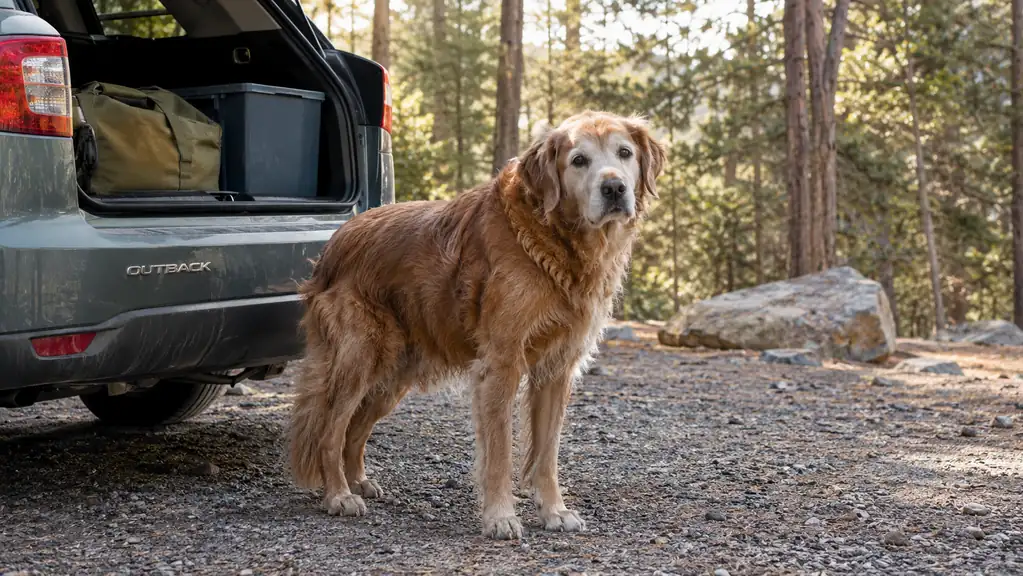
The first time I lifted Juniper into the back of the Outback with this harness, she looked back at me like I had finally lost my mind. Then she realized her back legs were actually supported, and she stopped scrambling. That is the honest version of how this review starts: not with a cure, but with a dog who stopped fighting the tailgate.
Juniper is an 11-year-old Australian Shepherd mix, about 48 pounds, with arthritis in her hips and a stiff left elbow. She has ridden along on every camping trip and road trip for nine years. The stiffness first showed up as hesitation before jumping into the back of the SUV, then as a slow start on cold mornings. I bought the Adjustable Dog Lift Harness from PICK hoping it would make the daily tailgate jump easier. Six weeks later, here is what I actually think.
The Quick Verdict
A genuinely useful rear-leg support harness for a senior dog who still wants to ride along, with padded handles that make the daily tailgate lift easier. It will not fix arthritis, and the drawstring closure takes practice, but it does exactly what it promises.
Amazon Check Today's Price →The rear-leg harness that made the tailgate jump easier
If your older dog hesitates before jumping into the car, this padded lift harness gives you something to hold onto. Check today's price on Amazon.
Amazon Check Today's Price on Amazon →How I've Used It
I have used this harness every day for six weeks. The daily test is the tailgate of our older Subaru Outback. Juniper can still hop up on her own most days, but she hesitates first, and on cold mornings she needs help. With the harness, I stand behind her, slide the harness under her rear, and lift with her own hop. It turns a two-person job into a one-person job.
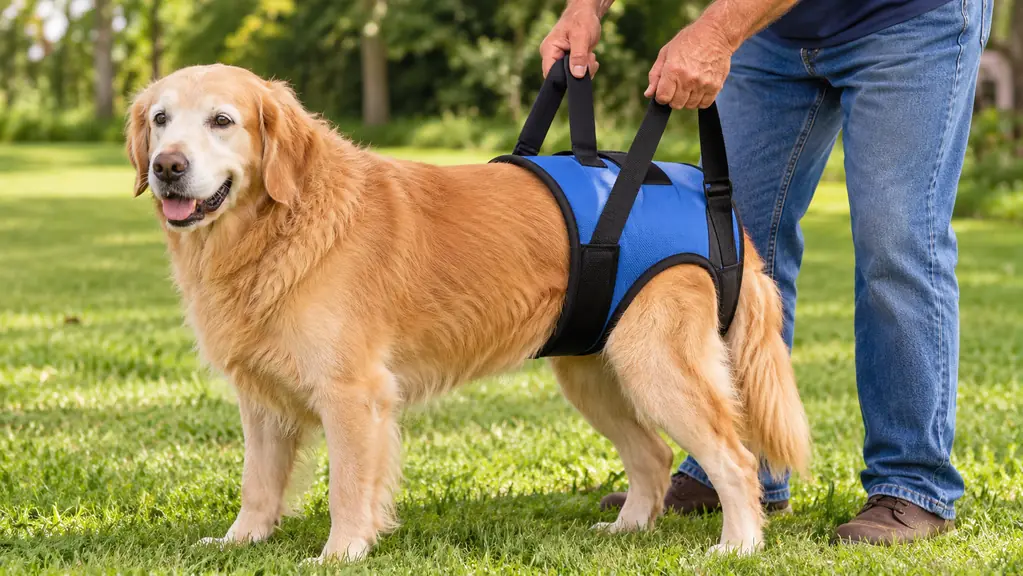
The first time I tried it, I made every mistake a person can make. I put the strap on too loose, and it slid up around her ribs. She stopped mid-walk and gave me a look that said, "What exactly are we doing here?" I tightened it, but then it rode too high and rubbed her belly. It took three or four tries over two days before I found the right position: the harness sitting just under her hips, the drawstring snug enough to stay put but loose enough that she could still squat to pee. Once I got that, everything changed.
We have also used it on gravel paths, at campsites, and on a three-day road trip to collect rocks for my garden. The harness lives in the back of the Outback, not in a drawer. That is the real test of any piece of gear: does it get used? This one does. On the road trip, we stopped at a rest area in Nevada at 6 AM. The ground was cold and uneven, and Juniper stood at the edge of the open tailgate, unwilling to jump. I reached for the harness, and two minutes later she was down and walking. That moment alone justified the purchase. One morning last week, the frost was still on the ground when Juniper and I went out. She walked stiffly to the tailgate and stopped. I did not say anything. I just reached into the door pocket, slid the harness under her rear, and lifted. She hopped up in one motion. My neighbor was watching from his driveway, and he asked if she was okay. I told him she was eleven and still had places to go. That is what this harness is for.
The harness is made of nylon, weighs 14.08 ounces, and comes with padded handles. The adjustable strap fits large to extra large dogs, with an adjustable length of 52 to 76 inches. For a 48-pound dog, the X-Large size works well. The drawstring closure lets me tighten it around her midsection, and the whole thing is machine washable, which matters after a muddy campsite walk. I washed it after a walk in the Sierra foothills, and it came out of the machine looking as good as the day it arrived.
What Nobody Tells You About Lift Harnesses
Here is the part most reviews skip: a lift harness does not lift the dog for you. It gives you something to hold onto. The padded handles transfer the weight from her rear legs to my hands, but I am still doing the lifting. If you are looking for a device that does the work on its own, this is not it. If you are looking for a way to make the daily tailgate hop easier, this is it.
The second thing nobody tells you: the drawstring closure takes practice. The first few times, I tightened it too loose and it slipped up her belly. Then I tightened it too tight and she gave me a look that could curdle milk. You have to find the sweet spot, and that takes a few tries. Once you do, it stays put. I would suggest practicing indoors on a soft surface before you need it outdoors, because the first time you use it in a hurry, you will not have time to figure out the strap.
The third thing: it is not a cure. Juniper still has arthritis. She still has stiff mornings. The harness does not fix her joints, and I would not trust any product that claimed to. What it does is make the moments between the stiffness easier: the tailgate hop, the step up onto the campsite platform, the moment she needs to pee at 6 AM and cannot quite squat without help. I have learned to read her body language. On a good day, she needs the harness once or twice. On a bad day, after a long drive or a cold night, she needs it five or six times.
One more thing nobody tells you: you have to be willing to use it. A harness in the drawer helps nobody. The first week, I felt awkward, standing behind my dog with a strap around her rear. It felt like admitting she was old. Then I watched her walk past the tailgate, turn around, and come back to me when she saw the harness in my hand. She understood it helped. After that, my pride got out of the way. I also want to be honest about the learning curve. The first time I used it at a rest stop, I fumbled with the drawstring for a full minute while Juniper stood there patiently. A truck driver asked if I needed help. I said no, because I did not. I just needed practice. By the end of the first week, I could put it on her in under thirty seconds. That is the kind of detail that does not make it into product photos.
The harness does not fix her arthritis. It makes the moments between the stiffness easier, and that is exactly what I needed.
Where It Shines
The PICK padded handles are the best part. They are wide enough to grip comfortably, and the cushion makes a real difference when you are lifting 48 pounds of dog several times a day. I have used harnesses with thin nylon straps that cut into my hands. These handles do not. Even on a cold morning, when my hands are stiff, I can get a good grip.
It is also genuinely portable. At 14.08 ounces, it folds down small enough to live in the door pocket of the Outback. I have used it at a rest stop in Nevada, at a campsite in the Sierra foothills, and in my own driveway. When you need it, it is there. When you do not, it is out of the way. On the road trip, I kept it on the passenger seat floor, so I could grab it without digging through the back.
The adjustable strap is another win. The 52 to 76 inch range means it fits a wide variety of large dogs. Juniper is on the smaller end of that range, and it fits her well. A friend's much larger dog tried it, and it fit him too. That versatility is useful if your dog's weight fluctuates, or if you ever need to help a neighbor's dog. The nylon material also holds up well. After six weeks of daily use, a muddy wash, and being shoved into the door pocket, there are no frayed edges and no loose stitching.
The machine washable care is a bigger deal than it sounds. Senior dogs have accidents. Juniper has had a few on cold mornings when she could not wait. Being able to toss the harness in the wash and hang it to dry means it does not become a smelly, stained piece of gear you dread touching. I washed it twice in six weeks, and both times it came out clean and ready to use.
Where It Falls Short
The PICK drawstring closure is the weakest part. It works, but it is fiddly. Every time I put it on Juniper, I have to adjust it. It is not a set-it-and-forget-it piece of gear. If you have limited hand strength or arthritis in your own hands, this could be frustrating. I do not have hand issues, and even I found it awkward for the first week.
The 7-day warranty is also worth noting. That is short. Most dog gear I have bought over the years comes with a longer warranty. It is not a dealbreaker, but it is honest information. If the stitching failed after a month, I would be out of luck. So far, after six weeks, the stitching is holding, but I would feel better with a longer warranty.
And the harness is not a full-body support. It only supports the rear. If your dog needs front-end support too, or if they cannot bear any weight on their back legs at all, this is not the right tool. For a dog who can still walk but needs help with the jump, it is perfect. For a dog who cannot walk, you need something more substantial. I tested this by lifting Juniper's rear while she stood on three legs, and it worked well. But when I tried to support her fully, the harness slipped, because it is not designed for that.
Another small thing: the strap can twist if you store it carelessly. The first time I pulled it out of the door pocket, it was twisted and took a minute to untangle. Not a big deal, but worth knowing. I now fold it neatly after each use, and it takes less than a minute.
What I Liked
- Padded handles are comfortable even when lifting 48 pounds several times a day
- Lightweight at 14.08 ounces and portable enough to live in the car door pocket
- Adjustable 52 to 76 inch strap fits large to extra large dogs
- Machine washable, which matters after muddy walks and senior dog accidents
Where It Falls Short
- Drawstring closure is fiddly and takes practice to get right
- 7-day warranty is much shorter than most dog gear
- Rear support only, not a full-body harness
- Will not fix arthritis or stiffness, only helps with the moments between
How It Compares to the Alternatives
I considered a hind-leg sling before buying this harness. The sling is simpler and cheaper, but it puts all the pressure on a narrow band of fabric. The harness spreads the support across a wider area, which is more comfortable for Juniper on longer lifts. I tried a friend's sling once, and Juniper tolerated it, but she clearly preferred the harness.
I also considered a full-body support harness with leg holes. Those are better for dogs who need significant assistance, but they are heavier, more expensive, and harder to put on. For Juniper, who just needs help with the tailgate and the occasional step, the lift harness is the right middle ground. It gives me the support I need without turning every outing into a production.
If your dog is smaller, a sling might be enough. If your dog is much larger, or completely unable to use their back legs, a full-body harness is worth the extra money. But for the common situation, a senior dog who can still walk but struggles with height, this style of lift harness is the most practical option I found. It is not the cheapest, and it is not the most heavy-duty, but it hits the balance that works for our life. I kept the receipt and the packaging for a week, just in case, and I did not need them.
Who This Is For
This harness is for the owner of a senior dog who can still walk, but who hesitates at the tailgate, struggles with stairs, or needs a little help on cold mornings. It is for the person who wants their dog along on the camping trip, not left at home. It is for the person who is willing to put in the practice to learn the drawstring closure.
It is also for the person who does not want to admit their dog is getting old. I was that person. I spent a month watching Juniper hesitate at the tailgate before I finally ordered the harness. I told myself she was fine, that she just needed a running start. The first time I used the harness, I realized I had been making her work harder than she needed to. If you are reading this and nodding, this review is for you. And if your dog still has good days and bad days, this harness is for the bad days.
Who Should Skip It
Skip it if your dog cannot bear weight on their back legs at all. Skip it if you need a full-body support harness. Skip it if you have limited hand strength and cannot manage a drawstring closure. And skip it if you are looking for a cure for arthritis, because no harness is that.
Also skip it if you are not willing to use it consistently. A harness that stays in the drawer will not help your dog. You have to be ready to stop what you are doing, get behind your dog, and lift. That takes a little time and a little patience. If that sounds like too much, a ramp for the tailgate might be a better investment for your situation.
Give your senior dog the support to keep riding along
The Adjustable Dog Lift Harness from PICK is the tool I reach for every single day. Check today's price on Amazon and see if it fits your dog's needs.
Amazon Check Today's Price on Amazon →