
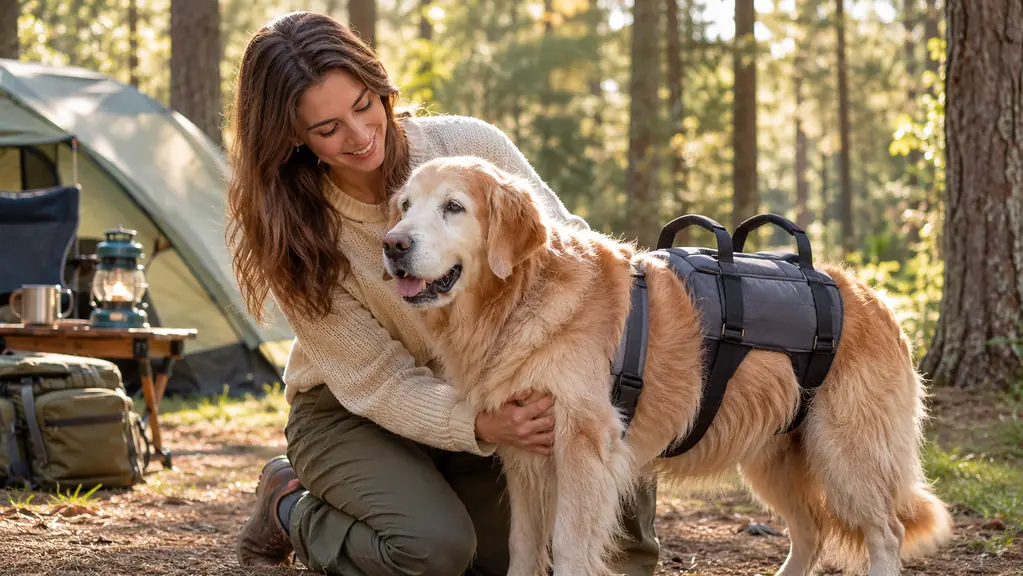
The first time I really needed a lift harness was a Tuesday in November. Juniper, my 11-year-old Australian Shepherd mix, stood at the open tailgate of my Subaru Outback and simply did not jump. She did the little crouch she has always done before a leap, then straightened up and looked at me. Not in pain, not whining. Just done with that particular jump.
We had camping plans that weekend, and I had a choice: cancel, lift a 48-pound dog by hand in a way that hurt both of us, or find something built for the job. I ordered the PICK FOR LIFE adjustable dog lift harness the same afternoon. Six months later, it lives in the back of the Outback with the camping chair, and it has earned its place more times than I can count.
The Quick Verdict
A simple, well-padded rear support that turns the daily tailgate jump from a two-person struggle into a one-person routine. Not a cure for arthritis, not a wheelchair, just honest mechanical help where an old dog needs it most.
Amazon Check Today's Price →The lift that keeps the camping trips going
If your senior dog still wants to come along but hesitates at the tailgate, this is the harness I reach for every single time. Padded handles, adjustable length, machine washable.
Amazon Check Today's Price on Amazon →How I've Used It
Juniper is 48 pounds, and she has arthritis in her hips and a stiff left elbow. Our vet and I manage her joints together, and the harness is part of that plan, not a replacement for it. The stiffness first showed about a year ago as a hesitation at the tailgate, and it has slowly become part of her mornings. I use it for three things, every week: the tailgate jump, the two steps down from the back porch, and the occasional trail moment where she needs a hand over a log or a rocky patch.
Before I ordered this harness, I tried two other things. A folded bath towel under her belly worked twice, then slipped sideways on the third try and scared her enough that she did not want to be touched near her hips for the rest of the day. A canvas strap from an old bag was too narrow and dug into her. Both of those failures are why the padded handles matter. They spread the lift across a wider area, and Juniper stopped flinching once she realized the harness meant help, not a grab.
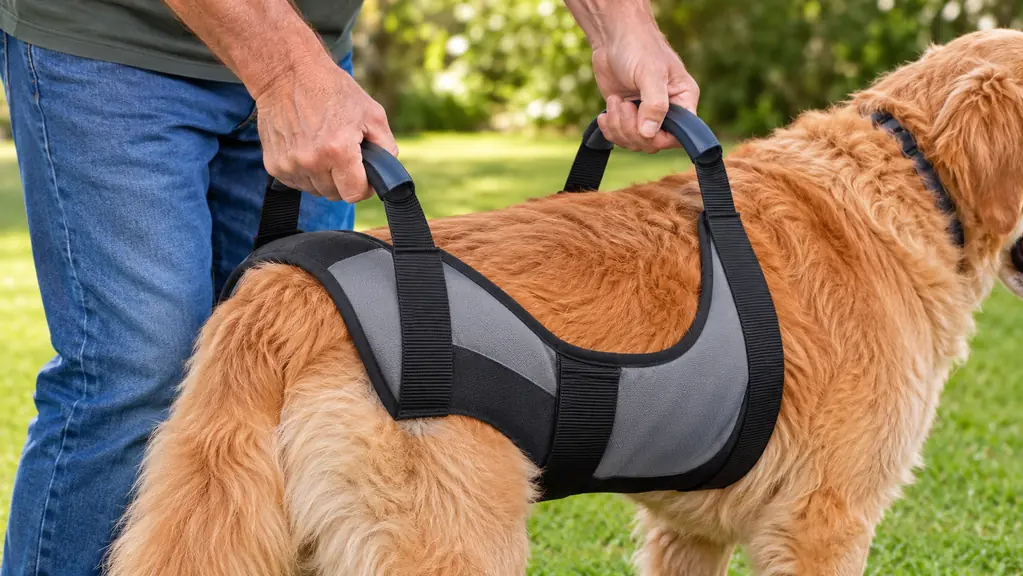
The harness is a nylon sling that sits under the belly and around the rear, with two padded handles on top. You slide it into place, adjust the strap to fit, and lift with the handles when your dog's back legs need help. The strap adjusts from 52 to 76 inches, so it fit Juniper with plenty of room to spare, and it would fit a much bigger dog too. The whole thing weighs 14.08 ounces, which means I keep it in the car without thinking about it.
In six months I have used it on cold mornings when Juniper's hips were stiff, after long drives when she was sore from lying in the car, and on a gravel trail in the Sierras where she needed help over a fallen log. The first real test was the Saturday after it arrived, at a campsite off Highway 50 near the American River. Juniper had ridden for an hour and a half, her hips were stiff from lying in the car, and the tailgate at the campsite sat higher than the one at home. I slid the harness on, gave a gentle lift, and she was in the back in one smooth motion. It has been rained on, stepped on, and covered in mud. I have machine washed it three times and it still looks and works like new.
What the PICK FOR LIFE Harness Actually Does
The honest description is simple: it gives you something safe to hold onto. Before this harness, helping Juniper meant grabbing her hips with my bare hands, which she hated and I hated more. The PICK FOR LIFE harness gives two firm padded handles exactly where you need them, so you can lift with your legs instead of your back.
The padding matters more than I expected. The handles are cushioned, which makes a real difference when you are supporting part of a 48-pound dog several times a day. My hands do not go numb, and the nylon webbing does not dig into Juniper's belly the way the towel did. The closure is a drawstring, which sounds flimsy but has held up fine through daily use, and the material is nylon, so it dries fast and rinses clean.
The first time I put it on Juniper, I was sure I had the strap wrong. The harness is sized X-Large, and the strap adjusts from 52 to 76 inches, which is a wide range, and it took me a couple of minutes to figure out how tight it should sit. The answer turned out to be snug but not tight. The sling needs to sit under the belly, just behind the ribs, and around the rear, so the weight spreads across the widest part of her body. Once I set it, I noted the strap position and have not changed it since.
The drawstring closure is worth a note. It looks like the cord on a pair of old sweatpants, and I expected it to be the weak point. Instead, I cinch it once, tie it, and it stays. The nylon webbing is the same material as a good hiking pack strap, and it rinses clean with a bottle of water if we are still at the campsite when she gets muddy.
It is also genuinely portable. At 14.08 ounces, it folds small enough to live in the side pocket of my camping chair bag. I have used it at three different campsites, at a rest stop in Nevada, and in my own driveway more times than I can count. The included components are just the dog lift itself, no extra pieces to lose, which is exactly what I want in a piece of gear that lives in the car.
How It Holds Up After Six Months
The first thing I checked when it arrived was the stitching, because that is where cheap lift harnesses fail. Six months later, the stitching on the handles and the strap is still intact. The nylon has not frayed, the padding has not flattened, and the drawstring closure still cinches and holds. I have machine washed it three times, and the color has not faded and the fabric has not stretched.
The worst test came on a February trip when it rained all weekend. The harness spent two days wet, got caked in the red mud of the campsite, and then sat in the back of the Outback for a week before I remembered to wash it. I expected the nylon to stiffen or hold the smell. It rinsed clean in the sink, went through the machine with the rest of the camp laundry, and came out exactly as it went in. I checked the seams under a bright light after that wash, looking for loose threads at the handle bases. There were none.
The adjustable strap is the part I was most skeptical about, because buckles and sliders are usually the first thing to break. After six months of daily use, the adjustment holds exactly where I set it. The slider is a simple piece of hardware, and simple is good here. There is no buckle to rust and no latch to jam. The strap slides when I want it to and holds when I do not. I tightened it once, about a week in, when I realized I wanted the handles a little higher so I did not have to bend as far. It has not moved since.
One thing I will say honestly: this is a tool, not a cure. It does not reduce Juniper's arthritis, and I have never expected it to. What it does is remove the scariest part of her day, the jump into the car, and replace it with a controlled lift that she stands still for. On days when she is stiff, she actually waits for me to get the harness ready. That tells me more than any spec sheet.
The Tailgate Test, Every Single Day
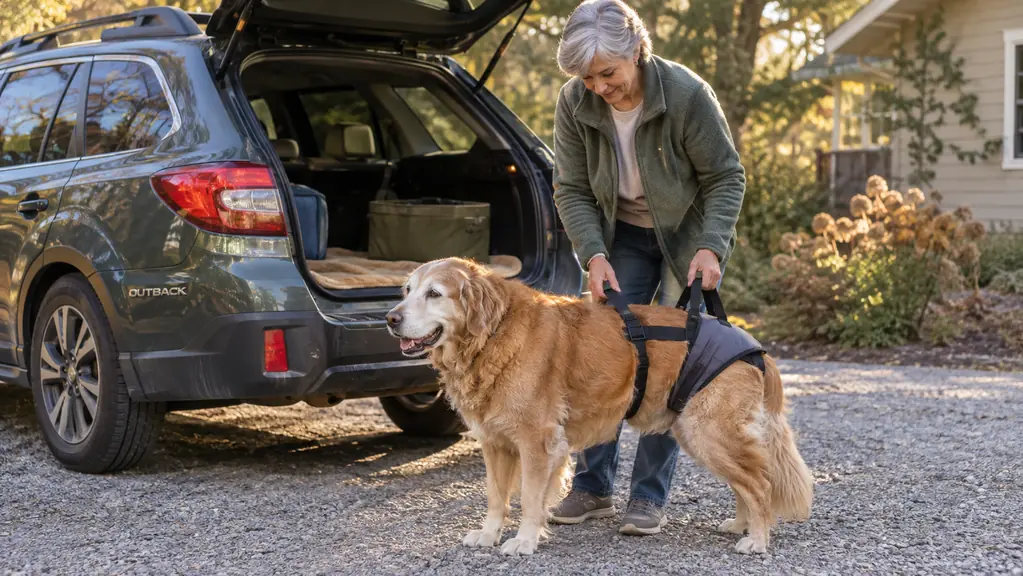
The tailgate of my Subaru Outback is the daily test for Juniper's hips. Nine years ago she sailed into the back without a thought. Two years ago she started hesitating. This year, on bad mornings, she would stand at the bumper and just look at me. The PICK FOR LIFE harness changed that routine completely.
Here is how it works in practice: I slide the harness under her belly and around her rear, position the padded handles over her hips, and give a gentle lift as she makes the small hop she can still manage. I am not carrying her, I am taking maybe a third of her weight off her back legs at the moment she needs it. She does the rest. It takes about ten seconds longer than the old jump, and it does not hurt either of us.
The coldest mornings are the ones that made me glad I bought it. When the thermometer reads in the high thirties and Juniper's hips are at their stiffest, she does not even attempt the little crouch. She stands at the bumper and waits. That is when the harness earns its keep. I slide it on, lift with my legs, and she is in the back in one motion. She settles onto her bed and curls up like the jump never happened.
The same routine works at the campsite, where the ground is uneven and the tailgate is higher than the driveway. On our last trip, Juniper walked a mile of gravel trail in the morning, rode in the car for two hours, and needed help out of the back when we stopped. The harness was in the side pocket of the chair bag, and the whole thing took less than a minute. Without it, that stop would have been a struggle. The strangest place I have used it was a rest stop in Nevada, three hours from home. Juniper had been lying in the car the whole way and could not lift her back end onto the bumper. A woman walking her own dog watched me slide the harness on and lift her out, and asked where I got it. I told her, and I meant it when I said I would not drive without it.
What I Liked
- Padded handles spread the lift across the widest part of the body, so Juniper stands still for it and my hands do not hurt afterward
- Adjustable strap from 52 to 76 inches fits a wide range of large dogs and holds its setting through daily use
- At 14.08 ounces it folds small enough to live in a chair bag pocket, so it is always in the car when I need it
- Machine washable nylon rinses clean and dries fast after mud and rain
Where It Falls Short
- Not a full-body support harness. It will not carry a dog who cannot bear weight on either back leg
- The drawstring closure takes a couple of tries to learn, and the package includes only the harness itself, so you figure out the fit on your own
- The 7-day warranty is short for a piece of gear I use every single day
The moment I knew this harness mattered: Juniper stood at the open tailgate, looked back at me, and waited for the harness instead of trying the jump on her own.
Who This Is For
This harness is for the owner of an older dog who still wants to come along. If your dog hesitates at the tailgate, needs help with stairs, or struggles to get up from a lying position, the PICK FOR LIFE harness gives you a safe, comfortable way to help without hurting your own back. It is especially useful for the large and extra large dogs this X-Large size is built for, and the adjustable strap from 52 to 76 inches means it fits a wide range of body sizes.
It is also for people who camp, travel, or take their dog on road trips. The portability is the feature I use most. At 14.08 ounces, it is light enough to keep in the car permanently, and it is machine washable, which matters when you are using it on a dog who has been rolling in dirt at a campsite. If your life with your dog involves a tailgate, a trailer step, or a cabin porch, this harness will earn its place.
Who Should Skip It
This is not a full-body support harness, and it will not carry a dog who cannot bear weight on either back leg. If your dog is completely non-ambulatory or needs full rear-end support for every step, you need a different kind of device, one that supports the whole rear body continuously, and you should talk to your vet about what fits your dog's specific condition.
It is also not a training tool and not a cure for arthritis. If you are looking for something that will fix a joint problem, this is not it, and no harness is. And if your dog is small enough to lift with one arm, you probably do not need this. For a 20-pound dog, a simple towel or a smaller sling is easier. This harness is built for the larger dogs, the ones where lifting by hand is genuinely hard on your back.
Keep your old dog on the trip
Six months in, the PICK FOR LIFE lift harness is the piece of gear I would not leave home without. If your senior dog still has places to go, this is the simplest way to help them get there.
Amazon Check Today's Price on Amazon →