
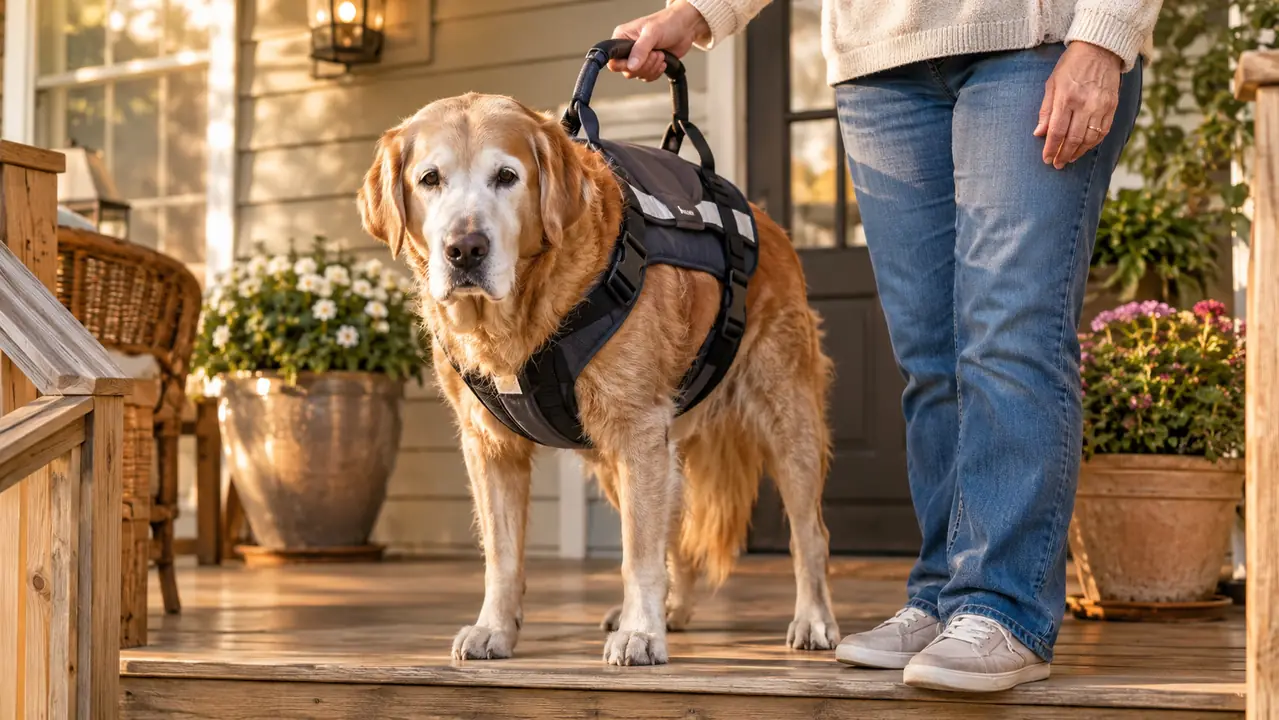
The first time Juniper hesitated at the bottom of the porch stairs, I told myself she was just tired. The second time, I carried her water bowl to the car so she would not have to climb back up. By the third week, I was doing the math every morning: two stairs to the deck, three steps down to the gravel, one jump into the back of the Outback. For an 11-year-old Australian Shepherd mix with arthritis in her hips and a stiff left elbow, that math was getting harder. I did not want to stop taking her camping, and I did not want to carry a 48-pound dog who still had nine good miles in her heart.
A lift harness is not a cure. It will not undo the arthritis, and it will not make the stairs disappear. What it does is give you a second set of hands under your dog's hindquarters at the exact moments her back legs need the most help. The PICK FOR LIFE Adjustable Dog Lift Harness is the one that has been on my shelf, in my car, and around Juniper's hips for the past several months. Here is how I actually use it, where it helps, and where it does not.
Give your older dog a hand on the stairs and the trail
The PICK FOR LIFE lift harness takes the strain off her hind legs at the moments that matter most. Check today's price on Amazon.
Amazon Check Today's Price on Amazon →Step 1: Put the harness on before you need it
The mistake I made at first was waiting until Juniper was already standing at the bottom of the stairs. By then she was tense, I was in a hurry, and the harness was a tangle of nylon straps in my hands. The first time I tried it that way, I dropped one of the handles, she stepped on the strap, and we both stood there in the cold while I untangled us. The better routine is to put it on at the door, before the morning stiffness has a chance to turn into hesitation.
The PICK FOR LIFE harness is a rear-leg support sling. It wraps around the dog's hindquarters, and the padded handles sit on top so you can lift from behind. The strap length adjusts, and the size range for this X-Large version is 52 to 76 inches. Juniper's girth measures about 25 inches, so the strap sits mid-range with room to tighten or loosen as her weight shifts between seasons. The nylon material is light enough that she does not seem to notice it once it is on, and the whole thing weighs about 14 ounces, so it is not adding weight to her day.
I put it on her after her morning leash, before we head out the door. It takes about a minute. The drawstring closure lets me adjust the fit over her hips without pinching, and the padded handles mean my hands are comfortable even when I am supporting a good portion of her weight on the way down the stairs. One Tuesday in late October, I tried a different order: harness at the back door, a minute to stand and settle, then the walk to the deck. She did not tense up the way she did when I fumbled with the straps at the bottom of the stairs. That was the day I stopped treating the harness as an emergency tool and started treating it as part of the routine.
Step 2: Use it as a steadying hand, not a forklift
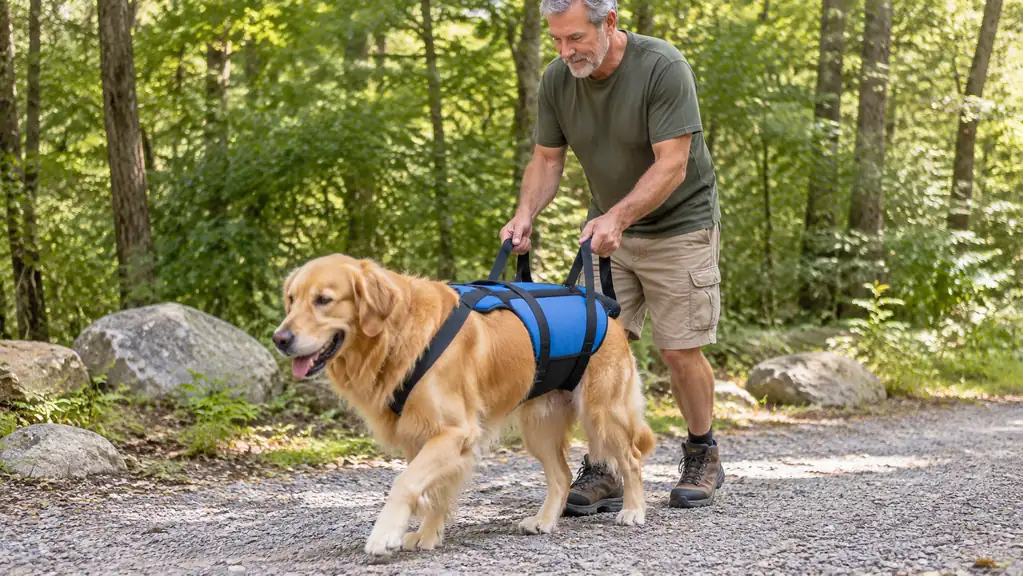
The biggest lesson I have learned is that a lift harness works best when you use it to take just enough weight off, not all of it. Juniper still has strength in her hind legs. What she lacks is confidence on a downhill slope or a set of stairs, especially on cold mornings when her hips are stiff.
When we come to the porch stairs, I stand behind her, take one handle in each hand, and lift just enough to feel her rear end lighten. She does the walking. I do the steadying. On the way down, that light lift keeps her back end from dropping too fast. On the way up, it gives her the extra push she needs to clear each step without dragging her toes. Last January, on a morning when the frost had not burned off the deck, she needed the lift on both the way down and the way up. I did not mind. It took thirty extra seconds, and we still made it to the trailhead before the parking lot filled.
The padded handles are the part that surprised me. I expected a thin strap that would dig into my palms on a long trail. Instead, the cushioning spreads the load well enough that I can walk a quarter mile with a hand under her rear and not feel it the next day. For a 48-pound dog, that matters more than I thought it would.
Step 3: Make the tailgate jump the easiest part of the day
Juniper has ridden along on every camping trip for nine years, and the jump into the back of the Subaru Outback used to be nothing. Last spring, she started standing at the bumper, front paws up, back feet planted, waiting. That waiting was the first sign that her hips were not what they used to be. The first time I used the harness at the tailgate was a Saturday morning in March, on our way to the coast. I slipped the handles under her hindquarters, lifted maybe ten pounds of her weight, and said 'up.' She hopped. It was not a jump, exactly, but it was not a struggle either. I stood there for a second and realized I had been putting off that trip because I was not sure she could still make the jump.
The lift harness has made the tailgate a non-event. I stand behind her, lift gently on the handles, and she hops up with most of her weight supported. Coming down, I do the same thing in reverse: a light lift that keeps her from jarring her joints on the landing. It takes the same amount of time as it did when she was five, and it does not hurt her pride the way being carried does. She still braces her front paws and pushes with her back legs. The harness just makes sure the push is enough.
The harness lives in the back of the car now, tucked behind the cooler. It is the first thing I grab when we stop at a trailhead, and the last thing I put away before we drive home. For a dog who still wants to come on every road trip, that little bit of help at the bumper is the difference between going and staying home. I do not use it for every jump anymore, only the ones that look hesitant, but I always have it within reach.
Step 4: Take it on the trail, but know its limits
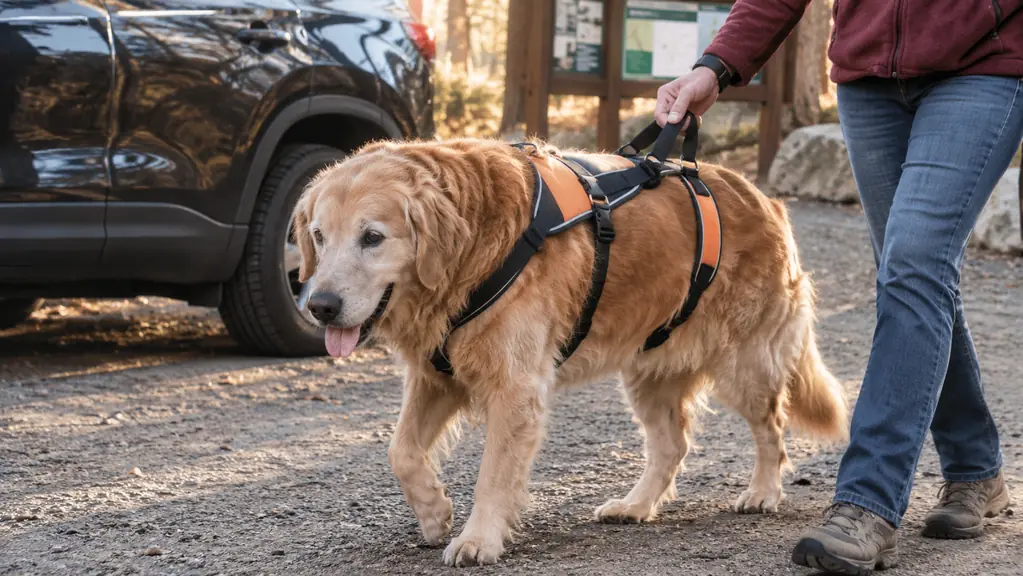
On flat ground, Juniper does not need the harness. She trots along on the gravel paths near the campsite with her nose down and her tail up, and the harness just hangs there, doing nothing. I have learned to let it hang. The moment we hit a steep downhill section, a set of rocky steps, or a stream crossing with a slippery bank, I reach back and take the handles. The clearest example was on a trail above the American River last fall. The path dropped about two hundred feet over a quarter mile, mostly loose gravel and exposed tree roots. By the third switchback her back end was drifting sideways on the downhill. I lifted just enough to keep her hips under her, and we finished the descent at her pace.
The harness is not a wheelchair and it is not a rescue device. It is a helping hand for a dog who still has good days and bad days. On a bad day, when Juniper's left elbow is stiff and her hips are slow to start, I use it more. On a good day, I barely touch it. The point is that it is there, ready, and it does not slow either of us down. After that American River descent, she spent the walk back to the car with her tail up. I do not think she would have fallen without the harness. I do think she would have been sore the next day, and I know she would have been more hesitant the next time I asked her to go down a hill.
One note for trail use: the adjustable strap is long, and on a narrow path it can brush against brush or rocks. I tuck the excess strap back through the drawstring closure so it does not catch on anything. It is a small thing, but it keeps the harness from snagging on manzanita branches and gives me one less thing to worry about. It also keeps the dangling end from dragging through mud on wet trails.
Step 5: Wash it, dry it, and keep it ready for the next trip
A lift harness that lives in a car and goes on camping trips gets dirty. Juniper has worn this one through mud, dust, and at least one unexpected dip in a cold creek. The dip happened in June, on the last day of a three-night trip near the Stanislaus River. She waded in after a stick, went in deeper than she meant to, and came out with the harness soaked and sandy. I rinsed it in the river, hung it over the tailgate for the drive home, and washed it that night. The care instructions say machine wash, and I have put it through the wash twice now. It comes out clean, the nylon dries fast, and the padding has held up without flattening.
The included components are simple: just the dog lift itself, no complicated buckles or straps to lose. The drawstring closure is the only adjustment, and it has not slipped or loosened during use. It also survived the wash without tangling, which is more than I can say for some of my own hiking gear. For a piece of gear that lives in the back of an older Subaru, that simplicity is a feature, not a lack of one.
I keep it hanging on a hook by the back door between trips. That way it is dry, visible, and ready. The morning routine is the same every day: leash, harness, coffee, and out the door. The harness is just part of the kit now, like the water bowl and the dog bed in the back of the car. The second wash came after a dusty stretch of trail in August, and it came out the same way: clean, dry by morning, ready to go.
What Else Helps
The lift harness is one tool in a bigger plan, and it works best alongside the things your vet recommends. For Juniper, that plan includes a joint supplement that I only adjusted after talking to our vet, shorter walks on cold mornings, and a ramp I built for the deck stairs at home. The ramp took an afternoon and a sheet of plywood, and it has taken the hardest part of the day off her hips. The harness covers the moments the ramp cannot, like the tailgate at a trailhead or a rocky section of trail a mile from the car.
I have also learned to watch her, not the calendar. Some mornings she bounds out the door. Some mornings she needs a minute to get going. The harness does not change that, and nothing should. It just means that on the slow mornings, she still gets to come along. That is the whole point. It is not about keeping her young. It is about keeping her with us.
The harness does not change that, and nothing should. It just means that on the slow mornings, she still gets to come along.
Give her the help she needs to keep coming along
The PICK FOR LIFE lift harness is the tool I reach for every single day. Check today's price on Amazon and see if it fits your dog's routine.
Amazon Check Today's Price on Amazon →