
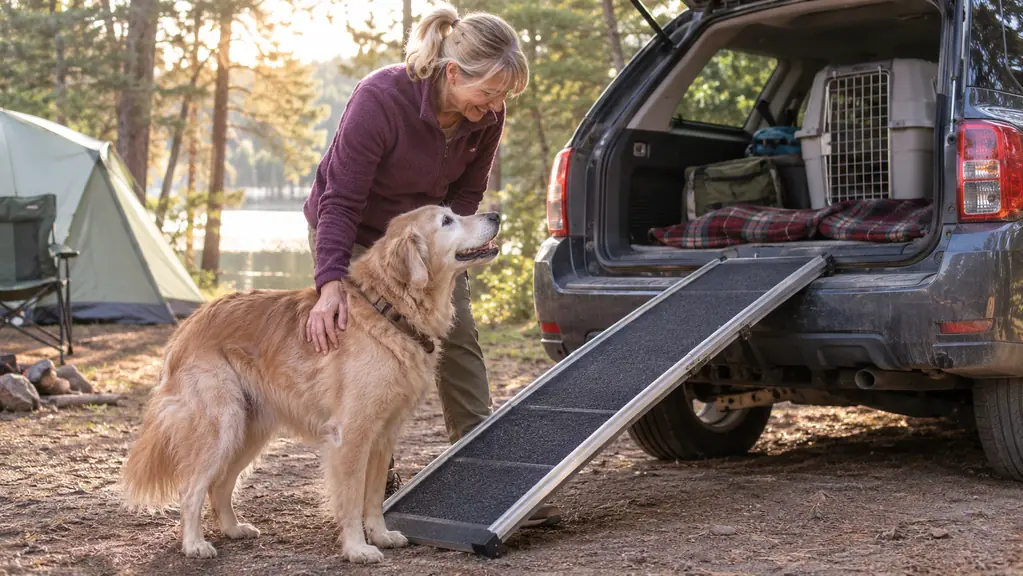
The morning Juniper stopped jumping into the Subaru, I stood at the tailgate with my hands on my hips and tried not to make it a big deal. She is 11, about 48 pounds, an Australian Shepherd mix with arthritis in her hips and a stiff left elbow. For nine years she had launched herself into the back of that Outback like it was nothing. Then one morning she just stood there, front paws on the bumper, back legs refusing to push. She looked at me like she was sorry. I told her she had nothing to be sorry about, and then I went inside and started researching dog ramps. The PetSafe Happy Ride Folding Dog Ramp came up in every search, and after a week of reading reviews, it was the one I ordered.
If you are here because your older dog has started hesitating at the tailgate, I want you to know two things before we get into the steps. First, the hesitation is not laziness. It is usually pain, or the fear of pain, and your dog is not being difficult. Second, a ramp is not a surrender. It is the opposite. It is how you keep taking a stiff old dog camping, on road trips, and everywhere else she still wants to go. This is the exact process I used to get Juniper back into the SUV, and I will tell you the parts that were easy and the parts that were not.
The ramp that ended our tailgate standoff
The PetSafe Happy Ride Folding Dog Ramp weighs 10 pounds, holds up to 150 pounds, and folds flat enough to live in the cargo area. It is the ramp I reached for every single day for the first month, and the one still in the back of the Outback today.
Amazon Check Today's Price on Amazon →Step 1: Measure the tailgate height and the space behind it
Before you buy anything, measure the height of your cargo floor from the ground. I used a tape measure at the back of the Subaru and wrote the number down: 28 inches. That told me the ramp needed to be long enough to make a gentle slope, not a steep plank. A ramp that is too short turns a 28-inch climb into a nearly vertical one, which defeats the whole point. On paper, the length of the ramp is the feature you are really buying, because length is what makes the angle gentle.
The PetSafe Happy Ride ramp is 62 inches long and 16 inches wide. I did the rough math before I ordered it: a 62-inch ramp at a 28-inch rise is about a 27-degree angle, which is gentle enough for a dog with stiff hips. A shorter ramp, say 48 inches, would have pushed that angle past 35 degrees, and that is the difference between walking and scrambling. I also checked the width of the opening between the bumper and the back seat, because a ramp that is too wide will not sit right, and one that is too narrow feels like a balance beam. Sixteen inches was plenty for a 48-pound dog with a confident walk.
One more measurement I almost skipped: the space behind the tailgate. The ramp needs room to lie flat on the ground before it angles up into the car. If you park close to a wall or another car, you will be fighting for that space every time. Give yourself a few extra feet of clearance at the campsite and in the driveway, especially in the first few weeks.
Step 2: Set the ramp up on flat ground and let the dog inspect it
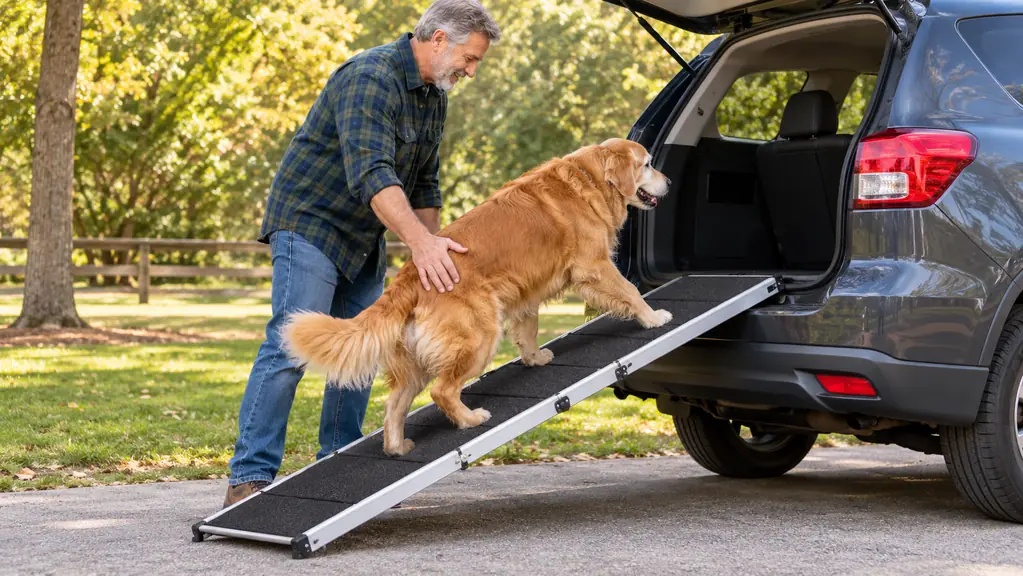
The first time I unfolded the PetSafe ramp, I did not put it anywhere near the car. I laid it flat on the grass in the backyard and let Juniper sniff it for as long as she wanted. The ramp has high-traction treads, side rails, and rubber feet, but none of that matters if the dog decides the whole thing is terrifying. Letting her inspect it on her own terms was the single best decision I made in this whole process.
When she was done sniffing, I put a treat at the bottom edge, then one a little higher, then one near the middle. She stepped on with her front feet, felt the surface, and stepped off. We did that for a few minutes and then I put the ramp away. Day one was not about getting into the car. It was about convincing her that the strange plastic thing was not going to bite her.
The second day, I raised one end onto the bottom step of the deck, just a few inches off the ground, and let her walk the full length for a treat at the top. She did it twice, then sat down at the top and looked back at me, which I took as approval. We repeated that little routine for three mornings before I ever mentioned the car. By then the ramp was old news to her, which is exactly what I wanted.
Step 3: Practice on the lowest possible height first
Here is the mistake I almost made: I wanted to go straight from the grass to the full tailgate height. That would have been too much too fast. Instead, I propped the ramp against the bottom step of the deck, which was only about six inches off the ground. Juniper walked up it for a treat, walked back down, and looked at me like I was finally making sense.
We did the deck step for two days. Then I moved to the tailgate, but I lowered the ramp angle by keeping the car on a slight incline in the driveway. The lower the angle, the more confident the dog. Every time she walked up and down, I used the same word, 'up,' so she started to connect the word with the action.
The ramp has a safety release latch and folds in half, so it was easy to carry from the deck to the car and adjust the angle each time. At 10 pounds, I could hold it with one hand while keeping the other on Juniper's collar. That mattered more than I expected, because the first few full-height attempts needed a steadying hand. The latch also meant I could fold the ramp up and carry it like a suitcase between the deck and the driveway, which sounds like a small thing until you are doing it four times a day.
Step 4: Walk beside the dog, never in front or behind
The first time Juniper stood at the bottom of the ramp at full tailgate height, she looked up, looked at me, and put one paw on the ramp. I was standing beside her, not behind her and not in front of her. Standing beside her meant she could see that I was not going anywhere, and it meant I could reach out and steady her shoulder if she wobbled.
I did not hold her collar and pull. I did not push from behind. I just walked up next to her, kept my hand light on her side, and let her set the pace. She took a step, paused, took another step, and then she was in the back of the Subaru, tail wagging, looking very pleased with herself. We celebrated like she had won a medal, because from her perspective, she had.
The side rails on the PetSafe ramp gave her something to feel on both sides, and the high-traction treads kept her feet from slipping. I could see her back feet planting with more confidence each time. By the end of the first week, she was walking up the ramp like she had done it her whole life, and the hesitation was gone.
One thing I learned the hard way: do not stand at the top of the ramp calling her. From down at the bottom, a dog looking up sees mostly sky and a person's silhouette, and that is intimidating. Standing beside her at the bottom, at her eye level, made the whole thing feel less like a performance and more like a walk. The one time I tried calling her from the top, she sat down at the bottom and refused to move until I came back down.
Step 5: Make the ramp part of the routine, not an event
The real test was not the first successful climb. It was the third week, when we loaded up for a camping trip and Juniper had to get into the car four times in one weekend. The ramp came out of the cargo area, unfolded, and went back in, over and over. Because it was part of the routine and not a big production, she stopped treating it as a challenge and started treating it as just the way we get in the car.
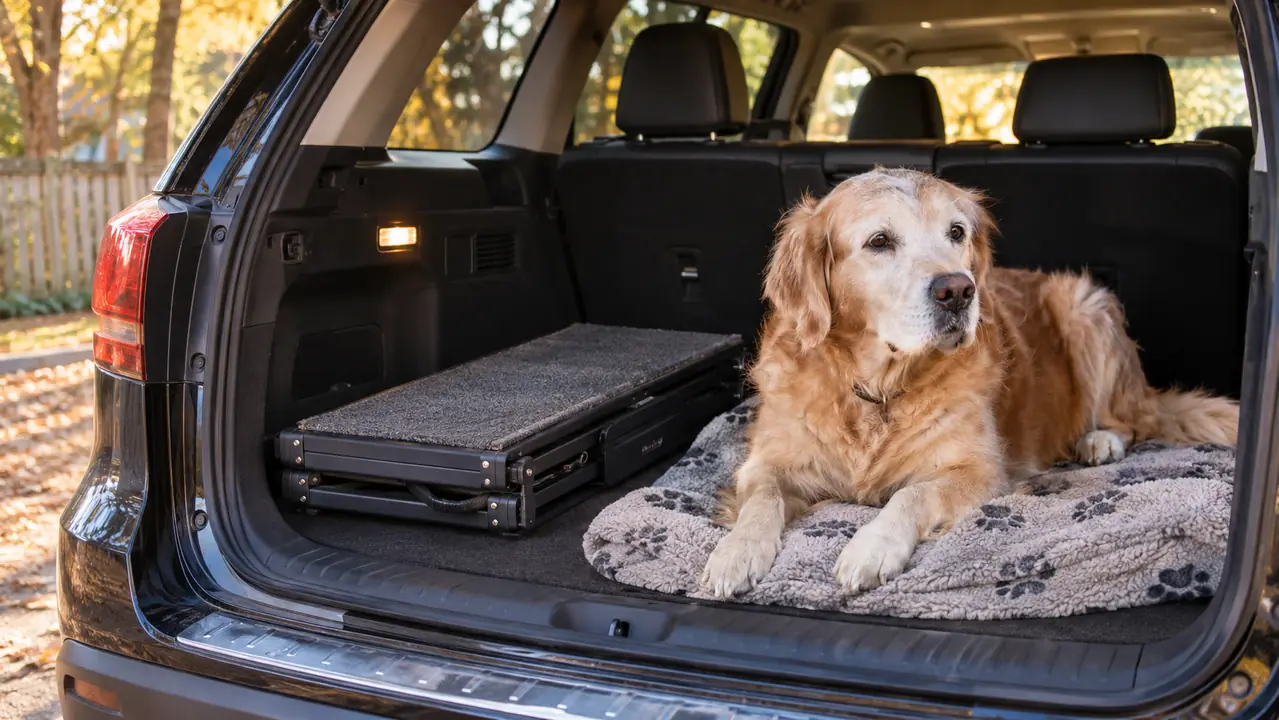
The PetSafe Happy Ride folds flat, which meant it could live in the back of the Outback without taking up the whole cargo area. That was the detail that made the routine stick. If I had to go find the ramp in the garage every time we went somewhere, I would have been tempted to skip it, and she would have been tempted to try the jump again. Keeping it in the car removed the excuse.
That first camping weekend, we drove four hours to a site in the Sierra foothills, and she used the ramp at the rest stop, at the campsite, and twice more before we came home. Each time took under a minute. The ramp also gave me a place to brace my hand when she came back down, because going down is harder on a stiff dog than going up. She learned to take the descent slowly, one foot at a time, and I learned to stand at the bottom and let her come to me instead of reaching for her.
Now, months in, the ramp is just part of the tailgate. Juniper waits at the bottom, walks up when I say 'up,' and curls onto her blanket. The morning stiffness is still there, and we still manage her joints with the plan from our vet, but the car is no longer a source of dread. It is the thing that takes us to the campsite, and she is ready for it.
What Else Helps
A ramp solved the car, but it did not solve everything. What helped Juniper most, beyond the PetSafe ramp, was a combination of small changes. I shortened her morning walk on cold days and let her warm up slowly. I put a nonslip mat on the floor of the cargo area so she had solid footing after the ramp. And I talked to our vet about her joint plan, because I am not a veterinarian and I do not pretend to be one. The ramp is a tool. The vet is the one who knows what is actually going on in those hips.
I also stopped rushing her. The old Juniper would jump out of the car the second the tailgate opened. The older Juniper needs a moment to get her legs under her before she walks down the ramp. Giving her that moment, every single time, is what keeps the ramp a positive thing instead of a stressful one. If you are patient with the process, the process gets faster. If you rush it, you start over.
She did not need to be lifted. She needed a way to keep doing the thing she loved, without it hurting.
Give your old dog the tailgate back
The PetSafe Happy Ride Folding Dog Ramp folds flat, weighs 10 pounds, and holds up to 150 pounds. It is the piece of gear that kept Juniper riding along on every trip this year, and it could do the same for your dog.
Amazon Check Today's Price on Amazon →