
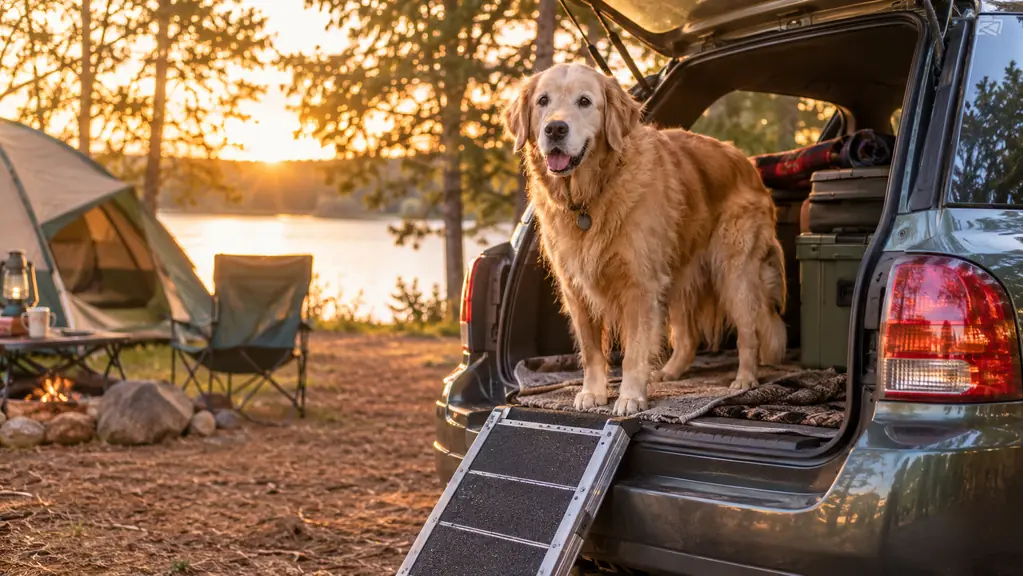
The first time Juniper hesitated at the tailgate, I thought she was just being stubborn. She was ten, still fast on the trail, still first to the door when I picked up her leash. But that morning she stood at the bumper of the Subaru with her front paws up, looked back at me, and stepped down instead of jumping. I didn't think much of it until it happened again the next week. Then the week after that. My vet used the word arthritis, and I started paying attention to every little thing she used to do without thinking.
Juniper is an 11-year-old Australian Shepherd mix, about 48 pounds, with arthritis in her hips and a stiff left elbow. She has ridden along on every camping trip and road trip for nine years, and she still wants to come on all of them. The PetSafe Happy Ride Folding Dog Ramp is the piece of gear that keeps that possible. I've used it for over a year now, through cold mornings, gravel campsites, and a lot of tailgates, and this is the honest long-term review I wish I'd had before I bought it.
The Quick Verdict
A lightweight folding ramp that turned the tailgate from a daily stress point into a non-event. It won't fix a dog's joints, but it will keep a senior dog riding along longer.
Amazon Check Today's Price →Keep the tailgate from becoming the hard part of the trip
If your dog hesitates before jumping into the car, that hesitation is the first sign the jump hurts. The PetSafe Happy Ride Ramp gives you a way to keep them coming along without asking them to land on sore joints.
Amazon Check Today's Price on Amazon →How I've Used It
I keep the PetSafe ramp in the back of the Outback full time, which is the real test. It lives under a cargo net with a camp chair and a bag of rock-hunting tools, gets pulled out at trailheads, campsites, and my sister's driveway, and it has been rained on, baked in the sun, and covered in mud more times than I can count. In over a year of that treatment, it still folds flat, still locks open, and still feels as solid as it did the first week.
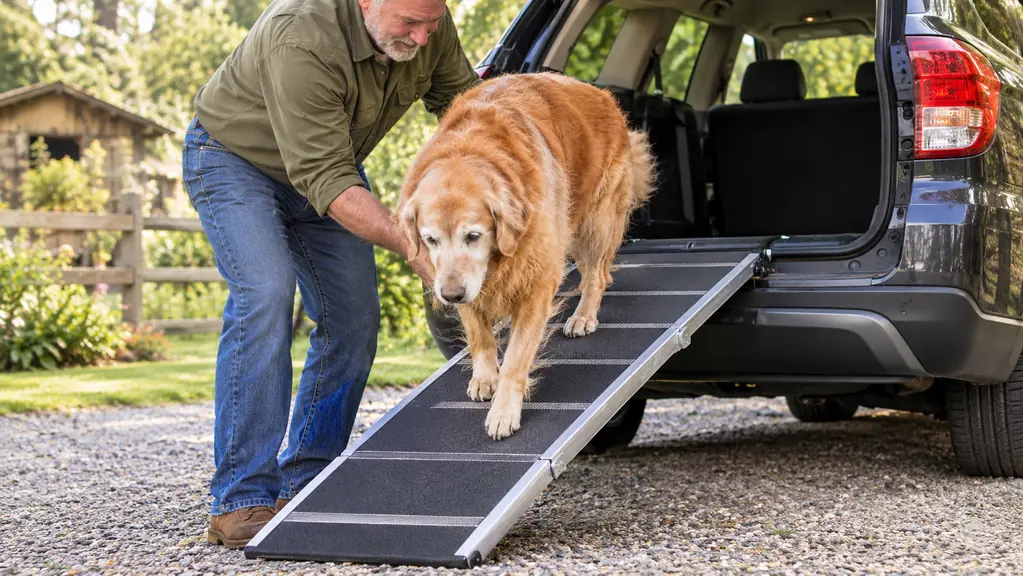
The ramp measures 62 inches long, 16 inches wide, and 4 inches high folded, and it weighs 10 pounds. That weight is the whole reason I actually use it. I am 61 years old and I do not want to wrestle a heavy ramp out of the back of the car at the end of a long drive. Ten pounds is easy to lift one-handed, easy to carry under an arm, and easy to set up without bending much. The bi-fold design means it opens in one motion and closes the same way.
Juniper uses it several times a week, not just on trips. The tailgate jump was the daily test, and now the ramp is the daily answer. She walks up it without being coaxed, waits at the top while I fold it, and rides with her head out the window like she did when she was five. The morning stiffness is still there. The ramp just means she doesn't have to add a jump to it.
The first real trip with it was a cold November weekend in the Sierra foothills, the kind of morning where Juniper's left elbow is at its stiffest. I set the ramp up at the tailgate before I even opened the back hatch, and she walked right up, no pause, no look back. That was the moment I stopped thinking of the ramp as a piece of gear and started thinking of it as part of the routine. She has used it in the rain, in the dark, on a sloped patch of gravel outside a motel in Nevada, and once on a muddy trailhead where I had to kick the rubber feet clear before they would seat. It has never once folded up on her mid-step.
What the Specs Actually Tell You
The PetSafe Happy Ride is a folding travel ramp rated for dogs up to 150 pounds, made of plastic, and built in the United States. The included components are the ramp itself, four rubber feet, a safety release latch, and a lifetime warranty. The manufacturer backs it with a 1-year warranty, which is worth knowing even though I haven't needed it.
The high-traction treads are the feature I notice most on cold mornings. Juniper's paws are dry and cracked in winter, and she used to slip on the plastic bumper of the car. On the ramp, her feet plant and stay planted. The side rails give her something to register against on the edges, and the rubber feet keep the whole thing from sliding on gravel or wet pavement. I set it up on packed dirt, on asphalt, and on a sloped campsite once, and it stayed put every time.
One thing the specs don't tell you: the plastic surface is smooth enough that a dog with very long fur can slide a little on the way down. Juniper has a thick double coat, and I've seen her back feet skid on the descent when the ramp is dusty. It hasn't caused a fall, because the traction strips catch her, but it's a real thing to watch for with a fluffy dog.
The safety release latch deserves more attention than it gets. It is the thing that keeps the ramp from folding while a dog is on it, and it is also the thing that makes the ramp easy to close when you are in a hurry. I have closed this ramp one-handed while holding a leash and a thermos, and the latch has never stuck, even after a winter of dust and pine needles worked their way into the hinge. The included components list mentions a lifetime warranty, but the practical coverage is the 1-year manufacturer warranty, and that is the one I would count on if something went wrong. I have not needed either, which is the best review a warranty can get.
How It Holds Up Over a Year of Real Use
The honest answer is: better than I expected. I bought the PetSafe ramp expecting a piece of gear I'd replace every couple of seasons, the way I've replaced collapsible water bowls and camp chairs. Instead, it has become the most reliable piece of dog gear I own. The folding hinge has not loosened. The safety release latch still clicks cleanly. The rubber feet are still on, which surprised me, because rubber feet are the first thing to fall off on most pet products. The worst treatment it got was a three-day trip to the coast last spring, when I left it leaning against the side of the Outback at the campsite and a storm blew through the first night. It rained hard for hours, and the ramp sat out in it, uncovered, until morning. I expected the hinge to stiffen or the rubber feet to swell. Instead I wiped it down with a towel, let it dry in the sun, and it worked like nothing had happened. That is the kind of thing that makes me trust it enough to keep it in the car full time, because the whole point of a travel ramp is that it is ready when you are.
The treads have worn smooth in the center, right where Juniper plants her front paws every time. That's the one visible sign of age, and it took about ten months of near-daily use to appear. It hasn't made the ramp slippery, but I'll probably replace it when the treads get worse, because traction is the whole point.
I've also learned where it works and where it doesn't. It works great at the tailgate of our Subaru, where the opening is wide and the bumper is low. It works at my sister's SUV, which sits a little higher. It does not work well on vehicles with a very high lift-over, like a lifted truck, because the 62-inch length starts to feel steep. For a standard SUV, van, or car, it's the right length. For something taller, you'd want a longer ramp.
The 10-pound weight is a genuine advantage for me. I can carry it in one hand while holding a camp chair in the other, and I can set it up without setting anything down. That matters more than you'd think at the end of a long drive, when the dog is excited and you're tired and you just want to get the tailgate open.
The Tradeoffs Nobody Mentions
First, the plastic construction. It's sturdy, but it's plastic, and it flexes a little under a heavy dog. Juniper is 48 pounds, well under the 150-pound rating, and the ramp felt solid under her from day one. I have also watched a friend's 90-pound Lab use it, and the flex was more noticeable, though the ramp held. If you have a very large dog near the top of that rating, I'd want to see it in person before trusting it. The flex isn't dangerous, but it's noticeable, and it is the main reason I would not want to use this ramp with a dog much heavier than that Lab.
Second, the width. At 16 inches wide, it's wide enough for a dog Juniper's size, but a broad-chested dog like a Lab or a Golden Retriever might find it narrow. They can still use it, but they'll walk more carefully, and a nervous dog might refuse. If your dog is built wide, measure their stance before you buy. Juniper plants her front feet about 10 inches apart when she walks, so she has room to spare, but a dog who stands wider will have to straddle the edges.
Third, you have to teach the ramp. Juniper took to it in about two sessions because she's food-motivated and I started with treats at the bottom, then the middle, then the top. The first session I did not even ask her to walk up. I just put a treat on the bottom edge, let her take it, and closed the ramp. The second session she went all the way up for a piece of chicken, and by the third she was waiting at the tailgate for me to set it up. But I've heard from friends whose dogs needed a few weeks, and one whose dog refused it entirely until they switched from a hard treat to something soft and smelly. Don't expect a senior dog to understand a ramp on day one. Give them time, use high-value treats, and don't rush the first few descents, which are scarier for most dogs than the ascent.
What I Liked
- 10 pounds and folds flat, so it actually gets used on every trip
- High-traction treads and side rails give a senior dog confident footing
- Rubber feet hold on gravel, pavement, and packed dirt
- Simple bi-fold design with a safety release latch that has never stuck
- Made in the USA and backed by a 1-year manufacturer warranty
Where It Falls Short
- 16-inch width feels tight for broad-chested or very large dogs
- Plastic surface lets a thick-coated dog slide a little on the descent
- 62-inch length gets steep on tall trucks and high lift-overs
- Treads wear smooth in the center after months of daily use
The ramp didn't fix Juniper's arthritis. It fixed the part of every trip where she had to decide whether the jump was worth the pain.
Who This Is For
This ramp is for anyone with a senior dog who still wants to come along. If your dog hesitates at the tailgate, stalls at the bottom of the stairs, or seems stiff after a ride, the PetSafe Happy Ride is a practical way to keep them in the rotation without asking them to jump. It's also great for a younger dog recovering from surgery, a dog with a neurological condition that affects balance, or a small dog who just doesn't like being lifted.
It's especially good for people who camp, because it folds flat and stores easily, and for anyone who drives an SUV or station wagon with a tailgate. If your dog is between 20 and 80 pounds and your vehicle has a standard lift height, this is probably the only ramp you need to buy.
Who Should Skip It
Skip it if your dog is very large and heavy, because the 16-inch width will feel tight and the plastic will flex more under the weight. Skip it if you drive a lifted truck or a tall van, because a 62-inch ramp gets steep on a high lift-over and you'd be better served by a longer, more expensive ramp. And honestly, skip it if your dog is small enough to lift comfortably. A ramp is one more piece of gear to store, and if you don't need it, you don't need it.
Also skip it if you're looking for something that will cure or prevent joint problems. A ramp reduces the strain of getting in and out of the car, which is genuinely valuable for a dog with arthritis. But it's not a treatment. Work with your vet on the actual joint plan, and use the ramp to make the rest of life easier.
A year later, it's still the first thing I pack
The PetSafe Happy Ride Ramp has been through a year of tailgates, campsites, and road trips, and it still does the one job I need it to do: get Juniper in and out of the car without a jump that hurts. If that's the job you need done too, it's worth a look.
Amazon Check Today's Price on Amazon →